Why Are SMEs Still Losing Time with Disconnected Business Tools?
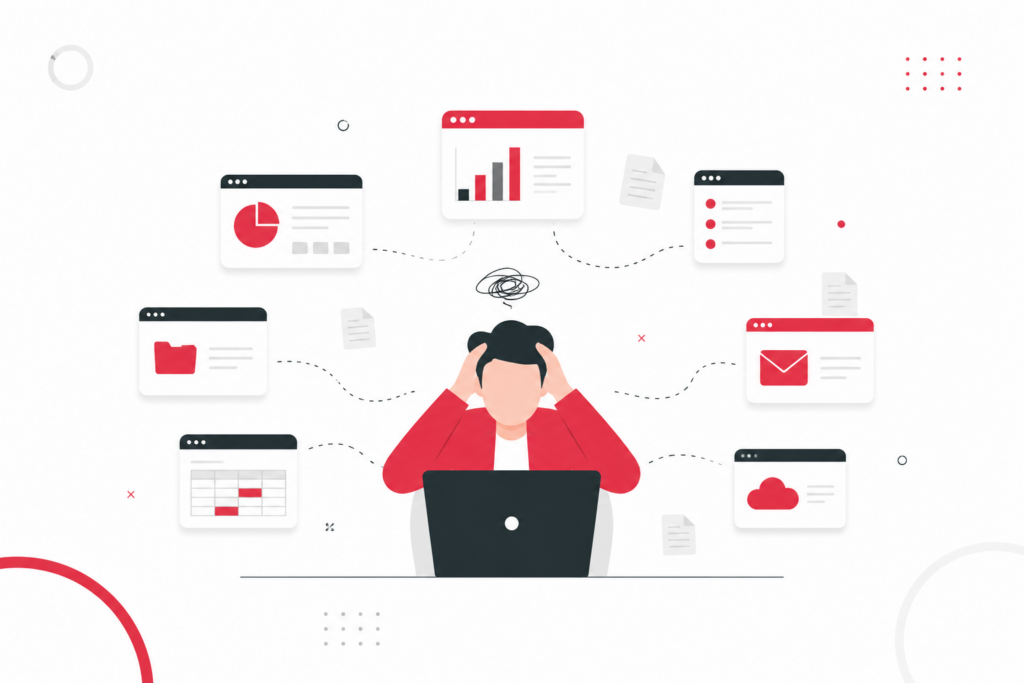
In many small and medium-sized businesses, employees switch between multiple applications every day: one system for accounting, another for sales management, a separate CRM, Excel spreadsheets, shared folders, and sometimes even paper documents.
While this setup may seem to work on a daily basis, it often hides a different reality: significant time wasted, manual data entry errors, and difficulty making informed decisions quickly.
As businesses strive to improve efficiency and remain competitive, relying on disconnected systems has become a major obstacle to growth.
In this article, you’ll discover why fragmented information systems slow down your business—and how modern digital solutions can help solve the problem.
What Are Disconnected Business Tools?
A business has disconnected tools when each department works with its own software without meaningful integration between systems.
For example:
- Accounting uses Sage.
- Sales teams manage prospects in a standalone CRM.
- HR relies on dedicated HR software.
- Quotes are created in Excel.
- Contracts are stored across multiple folders.
- Customer information is duplicated in several applications.
The result? The same data is entered multiple times, making it difficult to ensure accuracy and consistency.
The Daily Consequences
1. Significant Time Loss
Employees spend a considerable part of their day searching for information.
Depending on their role, they may need to open several applications before finding a document, quote, invoice, or customer history.
When multiplied across an entire company, these lost minutes quickly become dozens—or even hundreds—of wasted hours every month.
2. Increased Data Entry Errors
Whenever information must be entered into multiple systems, the risk of mistakes rises dramatically.
A wrong product reference, an incorrect customer address, or a forgotten update can easily lead to:
- delivery delays;
- invoicing errors;
- poor customer experiences.
3. Limited Business Visibility
Business leaders need accurate information to make fast, confident decisions.
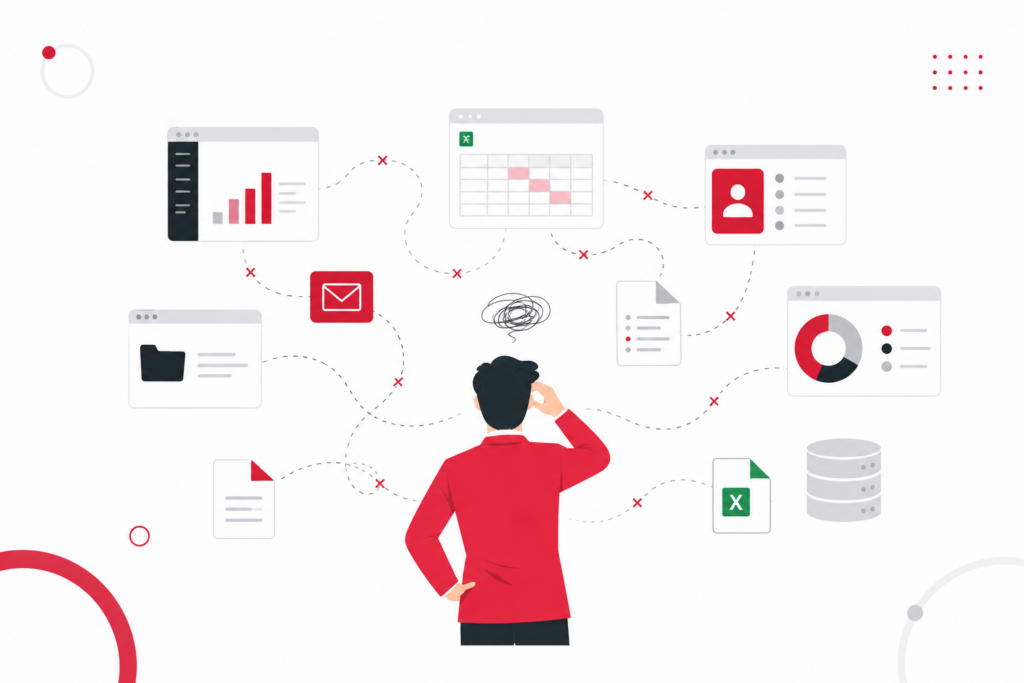
However, when data is spread across multiple systems, answering simple questions becomes surprisingly difficult:
- What is our real-time revenue?
- Which sales representatives are meeting their targets?
- What are our current inventory levels?
- What is our current profit margin?
The information exists—it is simply scattered across different applications.
4. Poorer Collaboration Between Teams
When every department uses different software, communication becomes more complicated.
Instead of creating value, employees spend more time requesting information from colleagues.
Limited visibility also creates misunderstandings and slows collaboration between departments.
The Hidden Costs of a Fragmented Software Environment
Many businesses believe they save money by keeping several small software solutions.
In reality, this often generates additional costs, including:
- multiple software subscriptions;
- maintenance costs;
- custom integrations;
- training on different systems;
- reduced employee productivity.
Over time, these hidden costs frequently exceed the investment required for a centralized business solution.
How Can You Regain a Complete View of Your Business?
The solution is not always to replace every application.
In many cases, companies can:
- connect existing software;
- centralize critical business data;
- automate data exchanges;
- eliminate duplicate data entry;
- create shared dashboards for all departments.
The objective is simple: provide a single source of truth that is reliable, up-to-date, and accessible to everyone.
A Successful Digital Transformation Starts with an Assessment
Before investing in a new ERP, CRM, or document management solution, it’s essential to understand your company’s actual needs.
Every organization has its own processes, challenges, and objectives.
A proper assessment helps identify bottlenecks, automation opportunities, and the solutions best suited to your business.
How OneSolutions Supports Businesses
At OneSolutions, we help SMEs and mid-sized companies across France, French-speaking Switzerland, and German-speaking Switzerland successfully manage their digital transformation projects.
Depending on your business needs, we provide expertise in:
- ERP solutions (Odoo, NetSuite, Sage, Infoniqa)
- CRM solutions (Salesforce)
- Document Management (M-Files, Zeendoc)
- Financial and HR Performance Management
- ERP and CRM Consulting
- Information Management
Our goal is not simply to implement software—we build integrated, scalable information systems that support your company’s long-term growth.
Conclusion
Disconnected business tools are more than just an IT issue. They directly affect productivity, data quality, collaboration, and your ability to make informed business decisions.
By centralizing your information and automating key business processes, you improve efficiency, gain greater visibility, and create a more agile organization.
The first step is understanding where your biggest operational bottlenecks truly are.
Expertise ERP spécifique à votre secteur

Solutions ERP pour l’industrie manufacturière
- Planification de la production
- Gestion des stocks et des achats
- Suivi en temps réel

ERP pour la finance et la comptabilité
- Automatisation comptable
- Gestion budgétaire et reporting
- Conformité légale

ERP sur mesure pour le commerce de détail et l’e-commerce
- Intégration POS, e-commerce, CRM
- Suivi des ventes et du service client
- Intégration CRM ERP pour booster la relation client