10 Signs Your Business Needs Digital Transformation
For years, businesses could successfully operate using a handful of standalone software applications, Excel spreadsheets, and well-organized manual processes. Today, however, customer expectations are rising, teams are working faster, data volumes are growing, and business processes are becoming increasingly complex.
Digital transformation is no longer reserved for large enterprises. It has become essential for small and medium-sized businesses (SMEs) as well as larger organizations.
Yet many business leaders continue to postpone digital transformation initiatives, believing their current way of working is “good enough.” In reality, several warning signs indicate that a company has reached the limits of its existing systems.
Here are 10 signs that it may be time to modernize your business.

1. Your Employees Enter the Same Information Multiple Times
A quotation is created in one application.
The same customer information is then manually entered into the accounting system, copied into an Excel spreadsheet, and finally added to another business application.
Every manual entry wastes valuable time and increases the risk of errors.
As your business grows, managing duplicate data becomes increasingly difficult.
2. Excel Has Become the Core of Your Business
Excel is an excellent tool for analysis.
However, when it becomes the primary system for managing quotations, inventory, orders, customers, and reporting, it quickly reaches its limits.
Common consequences include:
- Multiple versions of the same file
- Calculation errors
- Limited traceability
- Difficult collaboration between teams
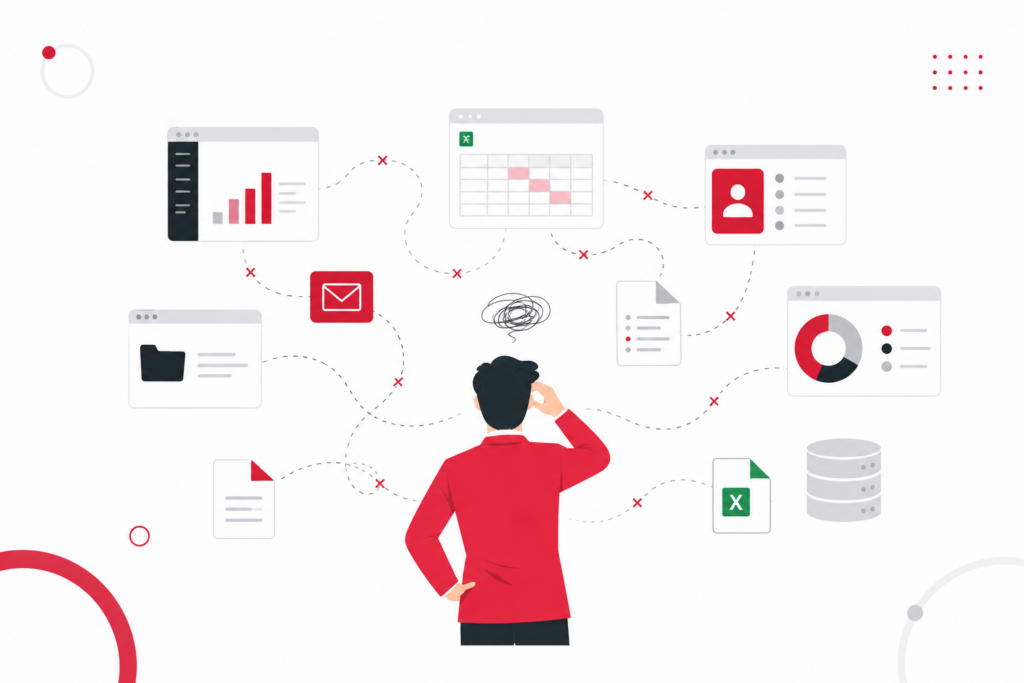
3. Your Software Doesn’t Communicate
Your accounting system operates independently.
Your CRM is completely separate.
Human Resources uses another application.
Your document management platform exists somewhere else.
Each department works with its own data, with little or no synchronization between systems.
This fragmented environment slows teams down and makes information sharing more difficult.
4. Employees Spend Too Much Time Searching for Information
How long does it take to locate:
- an invoice;
- a contract;
- a quotation;
- customer history;
- an HR document?
When information is scattered across different folders and applications, every search becomes a productivity loss.
5. You Lack Real-Time Visibility into Your Business
Can you answer these questions immediately?
- What is your current revenue?
- Which products generate the highest profit?
- What is the status of your customer orders?
- What is your current cash position?
If answering these questions requires several Excel exports, it is probably time to rethink your information system.
6. Administrative Tasks Consume Too Much Time
Many employees still spend several hours every week:
- copying data;
- manually sending emails;
- filing documents;
- checking information;
- recreating the same documents multiple times.
These repetitive administrative tasks add little business value and can often be automated.
7. Decision-Making Takes Too Long
Business leaders need reliable data to make informed decisions.
When every KPI comes from a different source, decision-making becomes slower and less reliable.
High-performing organizations rely on centralized, up-to-date information.
8. Your Teams Work with Different Versions of the Truth
Sales promises one delivery date.
Production has another.
Customer Service sees something completely different.
When every department works with different information, mistakes become inevitable.
A single source of truth allows every team to move in the same direction.
9. Your Business Has Grown, but Your Systems Haven’t
The software that worked well with ten employees may no longer be suitable once your company reaches fifty or one hundred people.
Growth naturally brings more customers, orders, data, and increasingly complex business processes.
Your technology should evolve alongside your business.
10. You Spend More Time Managing Software Than Growing Your Business
When software becomes a burden instead of a business enabler, it’s time to ask the right questions.
Digital transformation isn’t about adding more software.
It’s about simplifying everyday work, automating repetitive tasks, and improving the flow of information throughout the organization.

Digital Transformation Is About More Than Replacing Software
Many businesses believe digital transformation begins with selecting a new ERP or CRM.
In reality, the first step is understanding your existing business processes.
Ask yourself:
- Where are the bottlenecks?
- Which tasks consume the most time?
- Where does duplicate data entry occur?
- Which information is difficult to find?
Answering these questions provides the foundation for building a digital transformation strategy that truly meets your business needs.
How OneSolutions Helps Businesses
At OneSolutions, we help SMEs and mid-sized companies throughout France, French-speaking Switzerland, and German-speaking Switzerland successfully manage their digital transformation projects.
Our role is to help organizations streamline their business processes and implement solutions that align with their objectives.
Depending on your needs, we provide expertise in:
- ERP solutions (Odoo, NetSuite, Sage, Infoniqa)
- CRM solutions (Salesforce)
- Document Management (M-Files, Zeendoc)
- Financial and HR Performance Management
- Information Management
- ERP & CRM Consulting
Every project is tailored to your business challenges, existing processes, and long-term growth objectives.
Digital transformation is not about following the latest technology trend.
It helps businesses save time, improve collaboration, increase data accuracy, and make faster, better-informed decisions.
If several of the situations described in this article sound familiar, it may be time to assess your organization and identify the improvements that will deliver the greatest impact.
Expertise ERP spécifique à votre secteur

Solutions ERP pour l’industrie manufacturière
- Planification de la production
- Gestion des stocks et des achats
- Suivi en temps réel

ERP pour la finance et la comptabilité
- Automatisation comptable
- Gestion budgétaire et reporting
- Conformité légale

ERP sur mesure pour le commerce de détail et l’e-commerce
- Intégration POS, e-commerce, CRM
- Suivi des ventes et du service client
- Intégration CRM ERP pour booster la relation client